One at a time

Off-plan residential

One buyer per unit, from EOI through reservation and SPA to registration. Crosstable is the governed, shared inventory ledger between a developer and its broker channel — one sale per unit, through stages that expire on schedule, with every step audited.

Off-plan residential in Crosstable
The operation

The operation

A developer's sales and commercial team releases a tower's units to a channel of brokers and sells them off-plan — before the building exists. Each unit can be sold exactly once, through a regulated chain from expression of interest to reservation to signed SPA to DLD registration. Launches sell out in hours.

The inventory lives in an Excel "availability sheet" circulated on WhatsApp and PDF, and the double-sell happens not because staff are careless but because two people can confirm the same unit in the same minute. Lead CRM, public listings and developer ERP are all well-served; what still runs on the sheet is the governed developer-to-broker allocation ledger itself. In 2025 Dubai booked roughly 135,000 off-plan deals — exactly the pace at which a point-in-time spreadsheet guarantees double-bookings.
The gap

Where the spreadsheet fails here

Two agents see the same unit marked "Available" within minutes and both confirm before either writes back — and the sheet has no way to stop the second sale.

A reservation past its SPA-signing window stays "reserved" on the sheet, so the unit never returns to inventory and genuine buyers are turned away.

Who approved a discount below floor price, and why, is a cell that doesn't remember.

The availability sheet circulated to the broker channel on WhatsApp is already stale by the time it lands.

The model

How Crosstable runs it

Each unit can carry one active sale, and that sale moves through four ordered stages. The headline is the journey itself: a reservation is only good for a set window, and when a buyer misses the SPA-signing deadline the unit surfaces as overdue and goes back to inventory on an operator's say-so. Refusing the second sale closes exactly the pre-registration gap where two agents sell the same unit — the registry's lock, applied upstream, where the danger is.

The rule
One active sale per unit — closing the pre-registration gap that the DLD Oqood lock only closes at the end.
The journey
Available, then EOI, reservation, signed SPA and registration — and registered is final; it never expires.
Reservation expiry
A reservation is only good for a window you set; past it, the unit shows overdue and goes back on the market when the operator releases it.
Holds
A soft internal block distinct from a deposit-backed hard reservation — Crosstable keeps the two apart.
Governance
A second active sale on a booked unit is refused outright; a discount below floor takes a written reason and is audited.
Signature capabilities

Signature capabilities

One buyer per unit

Crosstable applies the registry's one-buyer rule upstream, where the danger actually lives — before registration, off a stale availability sheet.

The building-stack map

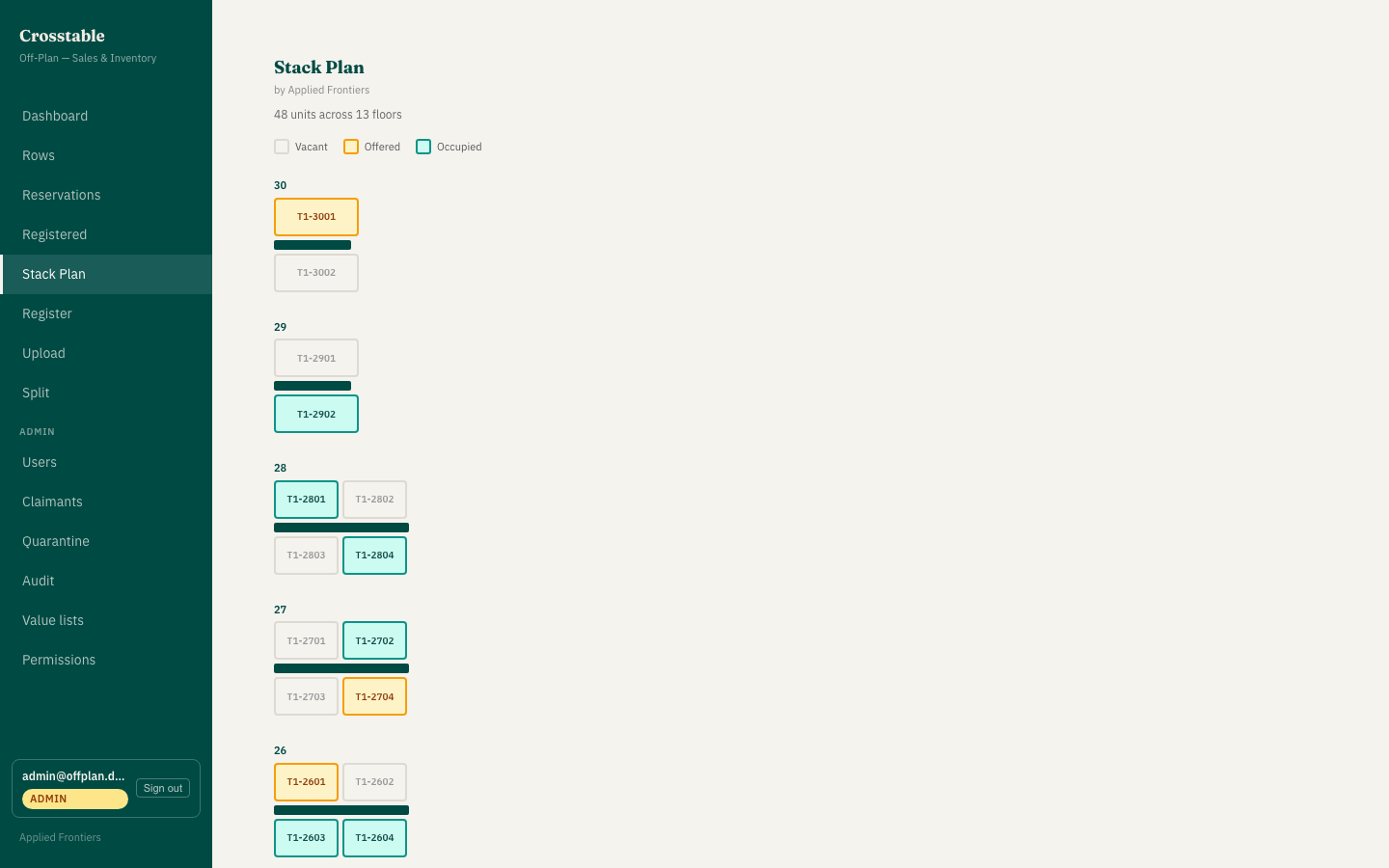
Each floor renders as a spine of units, floors stacked penthouse-at-top — the physical stack board every sales office prints, coloured by live status.

Four stages, each with proof

EOI, reservation, SPA and registration each need their own proof to advance — a broker reference, a token receipt, an SPA number, an Oqood number.

Reassignment via swap

Pre-handover assignment ("flipping") moves the sale to a new buyer, keeping the full paper trail — and only once a minimum has been paid.

EOI waiting list

Pre-launch expressions of interest form a dated queue on the scarce high-floor, sea-view stock.

Configurable to your operation

Configurable to your operation

Crosstable enforces one buyer per unit through the stages above. The numbers a developer will probe are settings — and each one says whether it's statutory or yours to choose.

The SPA-signing window and booking-deposit percentage — both per-developer, not statutory; Crosstable ships defaults and says so.

The buyer-default retention sliding scale, as a refund calculator for finance rather than an allocation rule.

Payment-plan schedules and escrow milestones that must be met before a sale moves on.

KYC / AML per party, versioned price-books, and proper handling of joint ownership and its shares.

Jurisdiction labels — Dubai RERA / DLD today, with UK exchange / completion and India RERA following the same shape.

Early access

See it on your tower.