One exclusive right of burial per grave — a rule written into law, with room to reserve ahead of need. Crosstable gives a burial authority a governed ledger of rights, grave capacity and expiry, and holds the one-right-per-grave rule the way the law demands.
A burial authority — a council, parish board, or private, faith or natural-burial operator — owns the land and inventory. A purchaser never buys the land, only the Exclusive Right of Burial: the authority may grant the exclusive right of burial in a single grave, dated, recorded and durable, under the Local Authorities' Cemeteries Order and its register-and-numbered-plan requirements.
Large councils run end-to-end suites, and public-search mapping is well-served. But the small, parish, private and faith tier still frequently runs this on paper bound registers and hand-drawn or Excel plot maps — with documented digitisation projects reconciling 140,000 manual records across 150-plus volumes. Grave scarcity is the sharpest driver: around half of England's cemeteries are forecast to run out within twenty years, which makes tight, auditable allocation discipline a live concern, not a nicety.
A paper register and a hand-drawn plot map drift apart, and a grave is accidentally granted twice — the cardinal sin of the trade.
A grave's remaining depth, and whether it can be reopened, isn't recorded anywhere a registrar can quickly trust.
Expired and dormant rights of burial go untracked, so scarce sections look fuller than they are.
Reconciling 150-odd bound volumes against a plan is a manual job nobody has time to do until a dispute forces it.
Each grave carries exactly one live Exclusive Right of Burial — not a metaphor, the statute's own rule. The part that looks like it needs a special case does not: the two or three deceased in a double- or triple-depth grave over time are sequential interment records under the single right, bounded by the grave's depth and requiring the current holder's consent to reopen. Only one right is ever live, so a grave can never be granted twice. The term runs decades out, so the right stays live with its expiry on display, and renewal or determination is handled as policy in its own time.
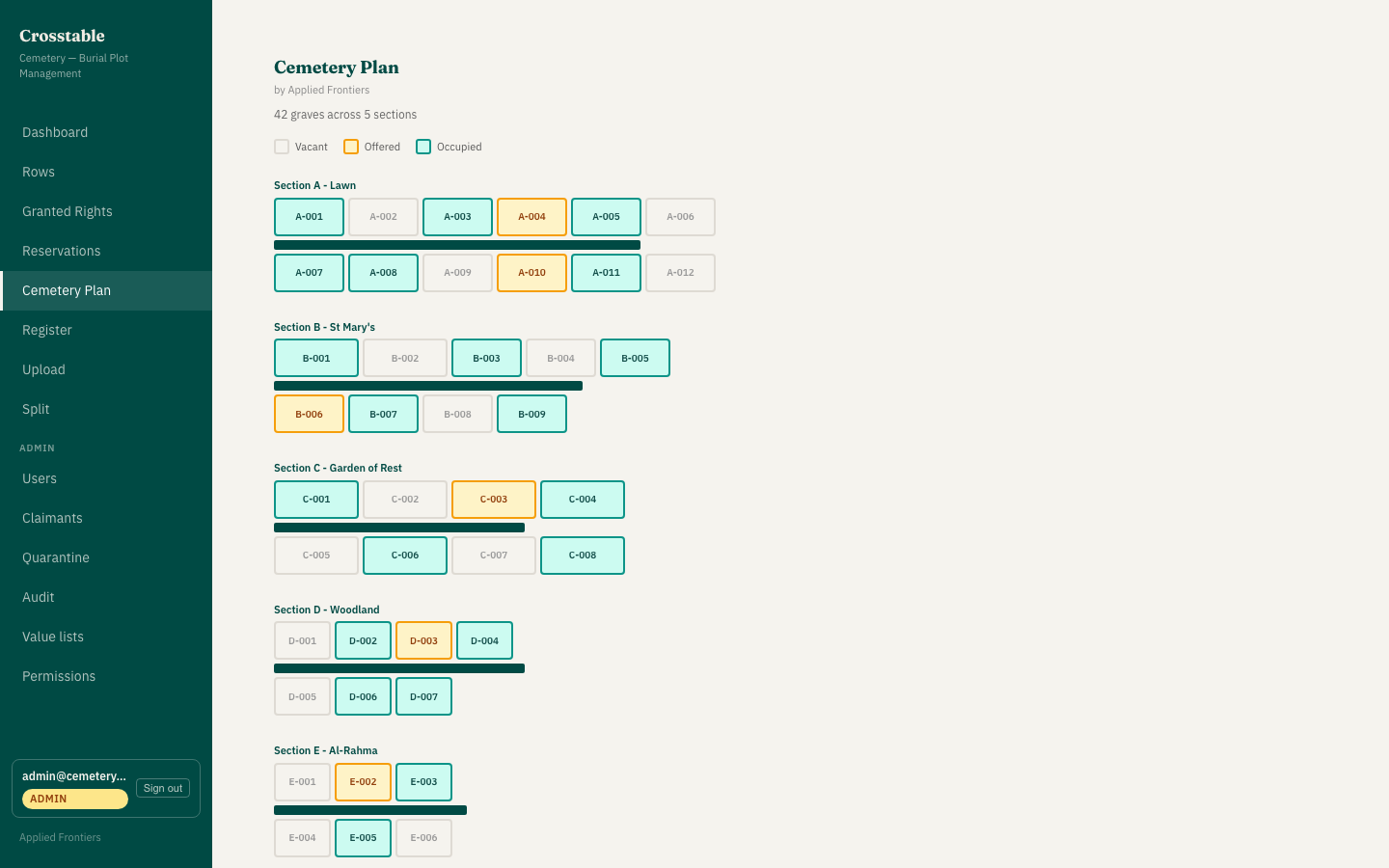
Plots on the numbered section plan the statute itself requires, coloured by occupancy, with deeper graves rendered wider.
Never two live rights on one grave — so the drift between paper map and register can't produce a double sale.
Reopening a double- or triple-depth grave appends an interment under the same grant, with the current holder's consent, bounded by the grave's depth capacity.
A dated queue on scarce sections — woodland, consecrated — with reason-mandatory out-of-order allocation.
The grant document is generated from the record itself, and a granted right flows to the register and to finance.
The core enforces one right per grave and records interments under it. The longer-horizon statutory workflows are the setup conversation.
Depth-capacity enforced as a hard rule, and the term-expiry, renewal and 75-year-determination grave-reuse workflow.
Transfer of the right on death — Deed of Assent or Statutory Declaration — as a holder-change with history.
Consecration and faith-section admissibility, and the memorial-permit approval sub-process with per-section rules.
The common-grave, no-exclusive-right path, and exhumation licensing annotations.
Per-authority fee structures — resident / non-resident, right versus interment versus memorial — and the US endowment / perpetual-care fund.