Committed storage that can't exceed the floor, by storage type. Crosstable is the forward commercial capacity layer above the warehouse-management system — who has how many committed positions, by storage type, against a floor that can only hold so much.
A third-party logistics operator sells committed storage — pallet positions — to many clients across a shared, multi-client warehouse, often cold-chain-capable. The commercial team books space; operations owns the physical floor and the oversell call; finance bills committed positions whether or not they're used. Shared and multi-client warehousing is roughly half the US 3PL-warehousing market.
The warehouse-management system owns the operational truth — inventory, putaway, picking, and activity-based billing of what already happened. What it doesn't hold is the forward commercial commitment: who is promised how much, by storage type, against physical capacity. That lives in an Excel capacity-planning sheet beside the WMS, and the documented pain is a 3PL quoting waitlists instead of dock dates with its biggest quarter scrambling.
Committed space is summed in a cell that doesn't separate storage types, so an ambient commitment quietly eats into frozen capacity that physically can't hold it.
The sheet tracks what's used, not what's promised — so the forward commitment that actually constrains peak season is invisible until the dock dates collide.
Oversell is run on instinct, with no view of committed-versus-physical capacity to tell you how far you've leaned.
A reserved position holds capacity before goods arrive, but the planning sheet only counts pallets once they're physically in.
The warehouse is a pool measured in pallet positions, and the committed space across all clients can never exceed it. Storage types are pools within the pool — ambient space can't become frozen space — so every booking has to fit both its type and the facility total at once. Committed positions count from the moment they're reserved, before goods arrive, while actual occupancy is a separate number mirrored from the WMS. Crosstable sits above the WMS and reads its actuals as a feed; it never becomes a second operational source of truth.
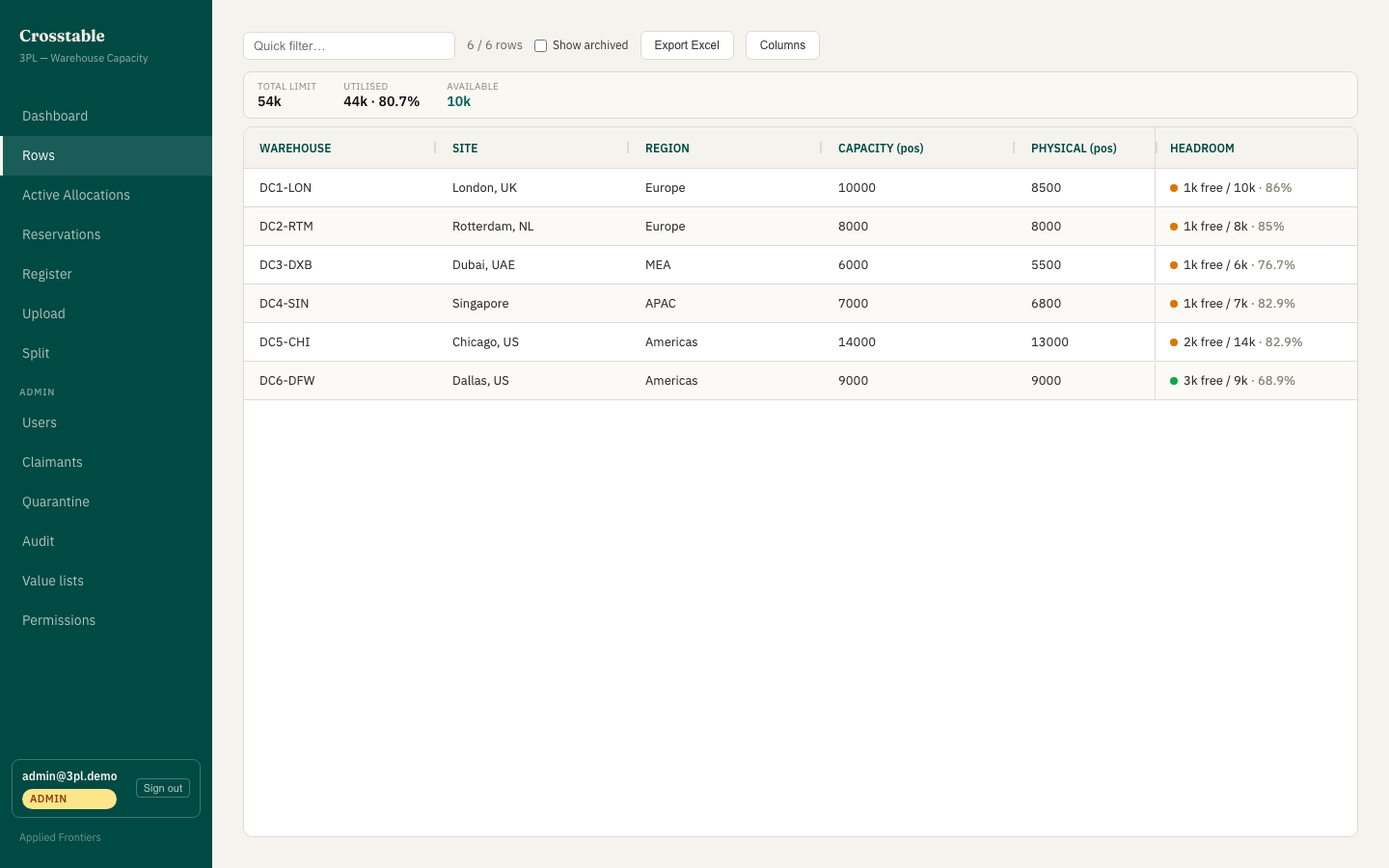
Per facility and per storage type: limit, committed, available — a portfolio banner, a pinned headroom column, and sub-limit bars that fill as space is sold.
Ambient, chilled, frozen, hazmat and bonded are physically and regulatorily separate pools; an allocation that fits the building but breaches its type is refused.
A reserved position counts against the pool from the moment it's held — you pay for reserved positions whether used or not — not when the goods roll in.
Commit more than the building holds, deliberately, with a clear view of committed capacity approaching a total set above physical.
The storage agreement is generated from the allocation, and active allocations are sent to billing and the WMS.
The core rule holds: committed space never exceeds capacity, by storage type and in total. The rest is the setup conversation.
The honeycombing or 85% effective-capacity flag — a soft advisory on occupied positions, below the hard committed invariant.
Committed-versus-used utilisation reporting as a second number alongside the commitment.
Overage and peak pricing, and minimum-guarantee billing.
Hazmat segregation distances and bonded-customs compliance attributes.
Dedicated-versus-shared contract nuances and seasonal peak-flex scheduling.